Wednesday, January 28, 2015

Mongolia: Homeland of heroic Genghis Khan and the Greatest Empire in the World in a long weekend

Part 1

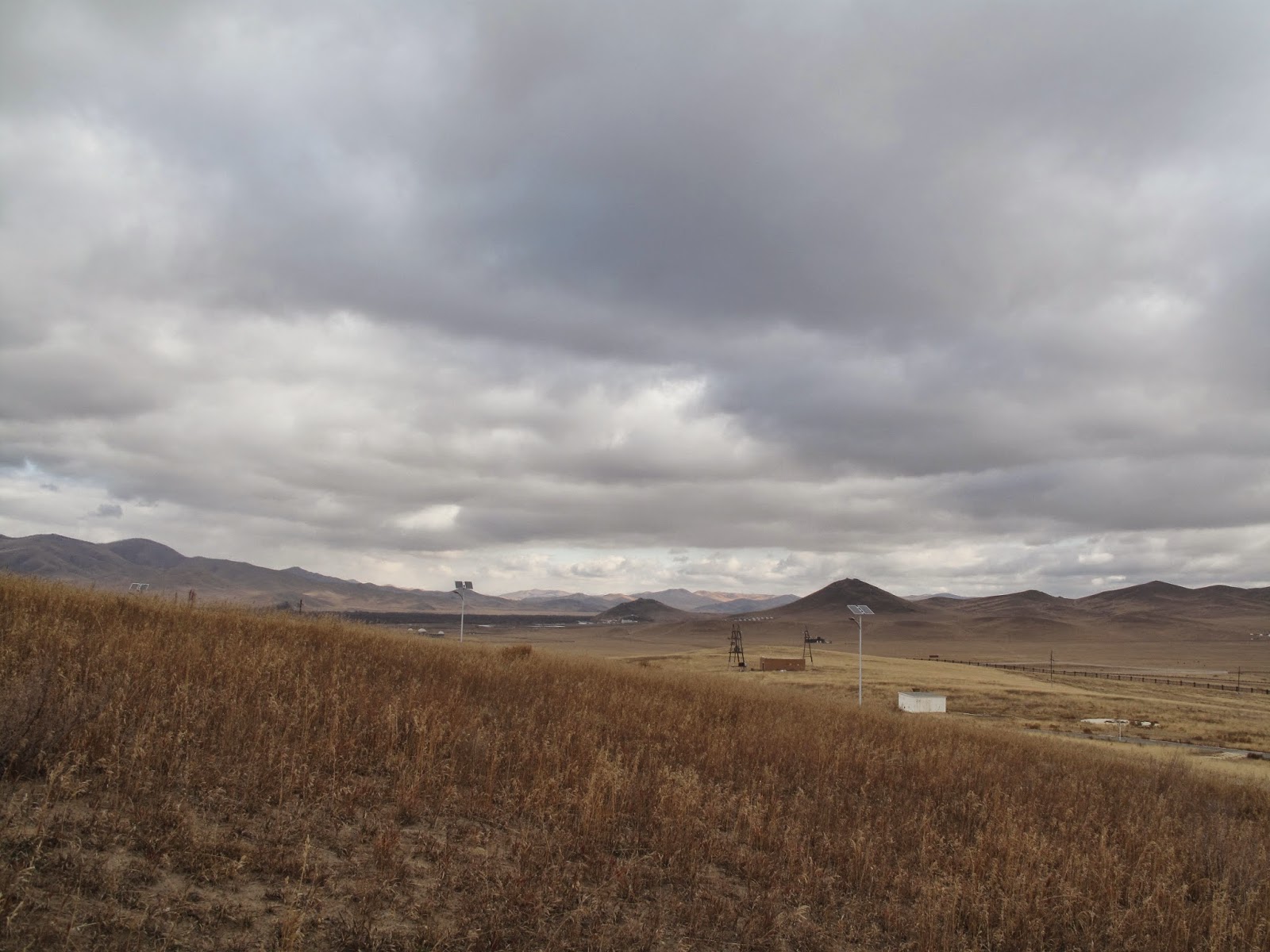
Some ashy gray background


I went to Mongolia last October.  Reflecting on it, October seems like a bad time to visit such a northern country, especially considering we only had a long weekend.  And due to wind delays pushing our flight back 12 hours, we basically just had a weekend.

Despite the logistical hangups and lack of a tight plan, the trip was amazing.  There are cheap, daily flights to Ulaanbaatar from Seoul.  The opportunity to visit wasn't going to come by again so easily so I pounced.


The hostel had the option to stay in gers, we opted for indoors since we arrived at 2 a.m.  Oasis Hostel gets my recommendation.

 
The decision to visit came as the result of using skyscanner.com and looking for cheap flights out of Korea.  I recommend the website if you don't have a planned destination because it lets you search for the cheapest flights from your location to anywhere.  Mongolia looked good by comparison.  I booked the flight and the hostel.
 
Just in time for arriving, I finished reading Genghis Khan and the Making of the Modern World by Jack Weatherford.  The biography (by one of my favorite non-fiction authors) really illustrates how revolutionary Khan was.  By the end of the book, I understood the strategic brilliance and unprecedented human rights conditions of the Mongol empire.


Did I say "human rights" and "Mongol empire" in the same sentence?  Yes. 
 
Besides conquering in 40 years more than Romans did in 200, the Mongols had a disciplined, honorable way of life.  They outlawed slavery and sex-slavery.  Women were given far more control over their lives than in most of the other parts of the 13 century world.  The Mongols outlawed torture, and the death penalty.  Genghis Khan also knew the power of a free press and freedom of religion.  He fostered a religious freedom that was completely unmatched anywhere else in that period- and even today.
 
Some of these policies are what helped the steppe people reach great new heights.  Their original life ways have sort of remained intact, sort of.

They got damn good food. And like most of Asia, it is extremely cheap.
 
Khan also had a great love of stuff, he wanted to open up trade routes and get more fancy things because the Mongols had so little.   This would regress into a form of greed that would be the undoing of his successors, but the trade routes and international relationships he forged helped pave the way for Pax Mongolica- a long period of peace.
 
The empire splintered over the centuries, Beijing was actually founded by Khan's grandson, Kublai Khan.  Mongolia was mighty, but a little less mighty over that time. 
 
Unfortunately, the Soviets suppressed Mongol independence for decades and really tried to erase the great legacy of Genghis Khan.  Long story short, they blew it, and now Mongolia is stuck between free consumer capitalism and the hollowed out remains of communism.  A precarious position for sure.


The capital, Ulaanbaatar usually gets a bad rap.  I found it delightfully garish.

Mongolia is the 19th largest country, but the population is only about 3 million, half of the people live in the capital. 
 
I don't imagine many people come to Mongolia for the city life.  Nonetheless, the center of the city was pretty vibrant and congested with cars and trucks.  I remember seeing a lot of Toyota Prius hybrids.  There were a lot of abandoned or incomplete looking apartment buildings and what I'm guessing were factories.  The skeletal reminders of the cold war, perhaps.  I can certainly imagine Westerners or people unaccustomed to less-industrialized countries seeing the place as horrible to look at.  I didn't feel that way though.  It was pretty relaxed, despite the hubbub.
 
It was interesting to hear our tour guide speak about his experiences with communism.  He mentioned his grandparents actually missed the old days when the community was closely bound together.  More on him later.


On the edge of the city people live in gers, albeit in a sedentary way.  Part of the genius of the Mongol empire was its ability to turn its nomadic life way into a war tactic.  Khan turned his strengths into weaknesses.  The nomadic herding way of life is quickly becoming a weakness in 21st century Mongolia, but it does still exist in the countryside.


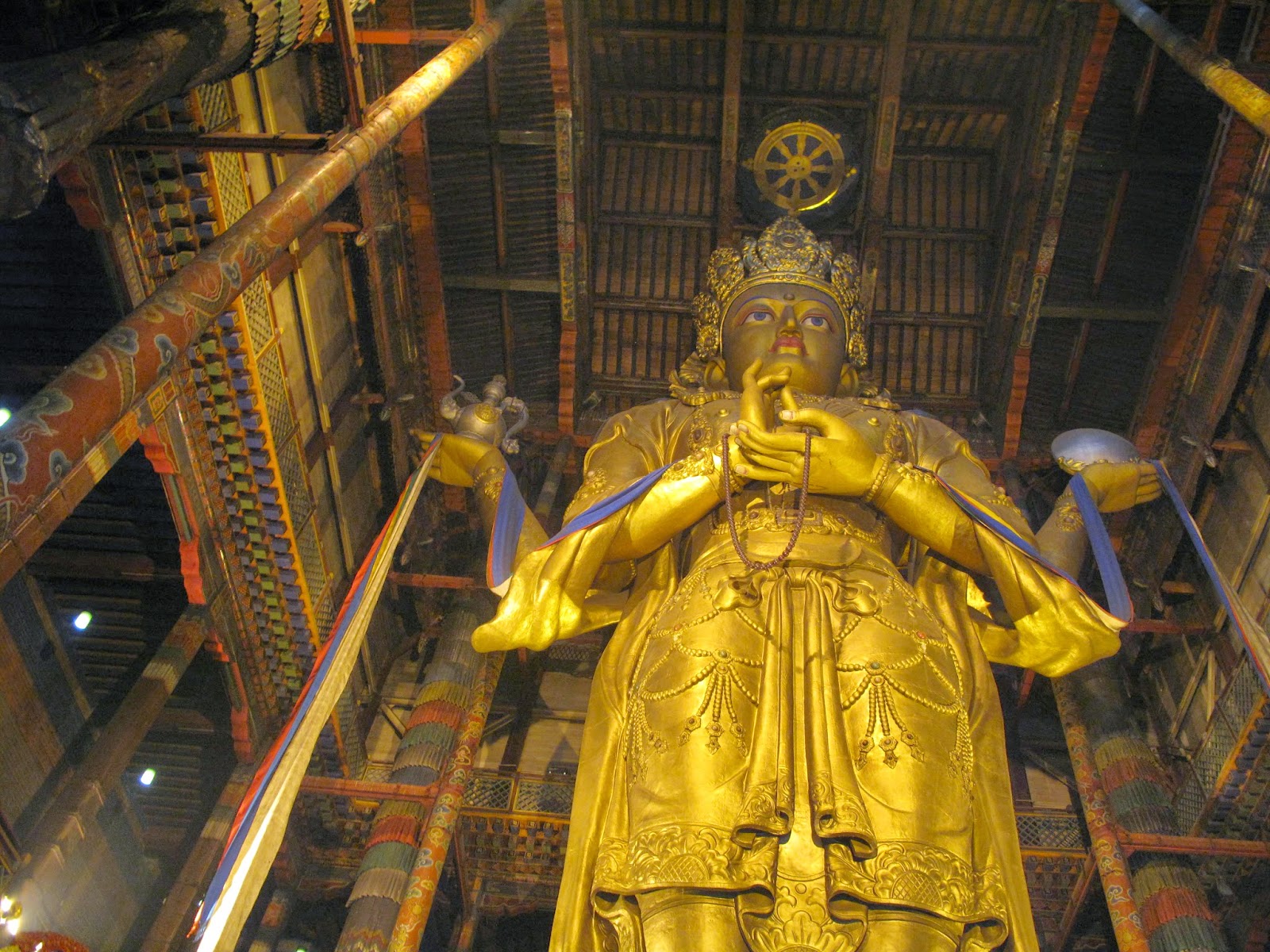
This was at Gandan Monetary, an amazing place.  One of the largest Buddha statues I have ever seen.


Part 2

Why Tour Guides Are Underrated

 
I never appreciated the benefits of a tour until I started traveling outside of America.  In that case you really need someone to bring the place into context.  I don't mean a tour group, per se, since that is a lot like being on a field trip with adults.  If you get the chance to hire a private guide (which sounds fancy, but it's really informal, and usually cheap), do it.  Your experience will be much more rewarding.
 

After a day in Ulaanbaatar, we ventured out to Terelj National Park and the largest equestrian statue in the world.  The same driver who our hostel arranged for our airport pickup became our guide again.  He was a gentle, intelligent man who spoke English almost without an accent, in addition to 4 other languages.  We arrived at the Genghis Khan statue before it opened up, so we took a little drive around.

 
The beauty was expansive, rugged and a cold.  The photos explain better than I can. 


One of my heroes. 
 
The monument had a nice museum inside.  I highly recommend it for history nerds.


This would be green in the summer, but I still found it stunning.  I suppose this might look drab to some eyes.

Terelj National Park is basically the main tourist excursion of the region, about 90 minutes outside of Ulaanbaatar.  The park was dotted with empty tourist camps and full of yaks and cattle grazing freely. 
 
It's not only worth the trip outside of the capital, but it really made the vacation feel complete.  The respiring winds and vast, austere silence were the perfect counterpoint to the struggles I was facing back in Korea.


This was a beautiful bathroom


The Siberian pine is apparently not evergreen


These meditative signs dotted the path up to the mountain temple.  You'll notice everything is in Cyrillic and not the vertically-written Mongol script (another Khan invention).
 
I still got a very strong sense of religious freedom in Mongolia, even though the only visible religion was Buddhism.  Our tour guide spoke of his studies of Sanskrit in India.  He shared the basic ideas behind the rituals like spinning the drums in the temple, and the meaning behind the symbols we found.  He said he respected all religions, I agreed completely.

 
Our tour guide gave us just the right amount of assistance and background.  In addition to being our driver the entire weekend.  Mongolia is impossible to see without a fast form of transportation.  I have a feeling I will be back some day to do the "overland" motorcycle journey.

 
The temple was peaceful, but I didn't get any good pictures of it.  The view from the top was enough to make me want to come back, hopefully when the timing is better.


Saying good bye


Wednesday, January 7, 2015

Poem - "Beirut"

Pussy
Cowboy Killer
Wrapping Paper
Beirut

Can you use a dollar bill for joint paper?
It's called wrapping paper and idk, lemme google it

Cowboy Killer-
Her friend called the Marlboros
I found it clever, with my wine

Tobacco is an Indian herb, sacred herb
not supposed to cause cancer originally

Hipsters stole leather and cigarettes and mohawks
from Native Americans.
Indians have been killing Cowboys
since 1492

I have had two former significant others express concern
at my pejorative use of the word "pussy"
once to describe pussy music- Beirut- watered down
like a bad Andrew Bird

We danced to him and other funk foundations
Sly Stone
on the porch

They wanted to be stars of indie music,
my friends, distant friends.
Who knows if they'll make it, I hope they do.

I don't remember the other time I felt bad for using "pussy" negatively
too long ago

She loved my homemade hummus.
My Lebanese-Italian American friend told me the secret to perfect hummus
Don't tell any white people, he said
and I haven't.

I'm about to fly to Cebu
Lapu Lapu airport, named for
Lapu Lapu
who killed Magellan
to defend his people

I hope my plane doesn't crash.

Wednesday, December 10, 2014

Hello again

I guess it's been a minute.  The reason I haven't updated has been a series of immensely stressful, physically and emotionally painful, life-changing, but ultimately- positive changes.

I'm single now.

I am actually considering staying longer in Korea, which I never thought possible.

I went to Mongolia.

I've been studying Korean and Spanish a lot more.

The school year is almost over.

I am going to the doctor on Friday for an endoscopy to examine a stomach pain that has persisted for over two months.  Hopefully, it's nothing major.  I am so so ready to not be sick anymore, the stress and illness have been tremendous burdens throughout my entire life in Korea.

I'm meeting new people and building the relationships with people I already knew.

I've gotten very close to someone who makes me feel excited to be alive again.

Who knows what the future holds.  I'm experimenting with meditation and positive thinking.

I want to re-examine things I thought I didn't need in my life, like spirituality.

I don't see myself teaching EFL for much longer, but I do want to teach in some form because it's an outlet from the rat race.

The U.S. is exploding in civic activism lately due to the outrageous police impunity and brutal crackdown on peaceful protests.  I want to go home and enact positive change, it's frustrating to be so far away.  The memory of all the innocent black people like Mike Brown and Eric Garner will not be forgotten.

I'm both discouraged, surprised but not surprised, and emboldened to change, to get behind the momentum towards peace.  Full and total peace.


Thursday, September 18, 2014

보신탕

보신탕 (Bo shin tang) is dog meat stew.  When the topic comes up, it elicits visceral responses, from Koreans and foreigners alike.  I have heard, directly from 3 Korean men in their 30's (age will come up later on this topic), and indirectly from my girlfriend about her coworker, the opinion that dog meat is delicious.  More delicious than cow or pig meat, they said emphatically.  Miming a scale with their hands pig was low, then cow middle and dog was the best.  Delicious.

I don't really care what people eat.  Let me rephrase that, I don't think it's right to criticize another person or another culture's attitudes about nutrition, agriculture, and health.  Without a doubt, the U.S. has the least healthy, most destructive, most repulsive and unsustainable food system on the planet.  We are destroying the world for convenience, for sweets, for caffeine, for hamburgers.  

We in the USA also have a great many white vegan know-nothings who hold self-righteous attitudes about ethical consumption but have absolutely no concern for the migrant labor who make their organic kale possible.  People who buy organic lettuce mix and don't know that the plastic container it came in cannot be recycled by an average local recycling plant.   People who constantly harass the choices of the poor, the choices of people of color, the choices of anyone not like them because they don't approve of it.  


But I'll get back to dog meat.  

You have to really come to terms with the cashing in on the term organic.  Think about what organic (which is often ambiguous across borders and from one food to another, and not an end in itself) means in a capitalist mega-lucrative agribusiness context.  Here organic means nothing, ethically.  Sure, the planet may be a tiny bit better off.  But local living and not eating meat and buying organic are not going to save us.  I am a pessimist.


I also love animals and I always have.  I have dabbled in vegeterianisn for almost ten years.  Before coming to Korea I was a somewhat strict vegetarian, but now I eat meat.  I wish I didn't but I do, sometimes.  It's just easier to take what I am offered at the school lunch.  The amount of meat Koreans consume can be astonishing.  It is often combined with a lot of vegetables so it's not like Americans with their Steak and Fries.

When it comes to dog meat I have no interest to try, but I also have no revulsion to the idea.  Meat is meat.  Pigs are as intelligent as dogs, perhaps smarter.  The longest walk that a pig takes in its entire life is to be slaughtered.  There are more chickens than human beings.  The energy it takes to feed and provide for a cow could probably power an entire village in a subaltern economy, probably.  I only made up that last one.  

Do Koreans eat dog? 

Yes. And No.  I have asked quite a few people.  Most expressed indifference (the pretty widespread indifference to political issues is perpetually puzzling to me, but I don't have a right to know as an outsider).  Some expressed a love for dog meat, some were disgusted.  It seems to be a more rural, older generational thing.  I read another white guy who blogs on TEFL in Korea, whose opinions I don't agree with, saying that the eating of dog will go away as the older generation starts to leave us.  I have no idea where he was getting that concept and my evidence points to the opposite conclusion.  It probably will never go away. 

[[ TANGENT, RANT WARNING There is a vast amount of misinformation on Asian culture.  It's part of what helped the West dominate the East for so long.  Asian countries are admirable for how much they don't give a fuck about Westerners.  The opinions of Westerners.  See, it's a racial issue because white culture likes to perceive itself as on top, as relevant, as the moral barometer for the world AND IT'S JUST NOT.  People can pursue their cultural traditions in any way they want. 

For example, Islam does not oppress women.  If you want to claim it does, then you have to start with speaking to Muslim women.  That should be step 101, asking women about their own experiences.  Instead, white feminists come into the picture with the idea that they are correct and right.  White feminists oppress women in the Islamic community by telling Muslim women how not to dress, not hearing the common idea that their devotion is usually the main reason for their clothing, it's not necessarily an expression of injustice.

Cultural criticism is only right to do about, within, in regard to your own cultural community.  Sorry, colorblind white dudes.  I know you love to pretend you dole out equal criticism across cultures BUT YA DON'T.  Every culture has good and bad DUH, the point is to criticize your own culture to make it better.  Anything else is brazen nay-saying- external, elitist, removed from context, and very often- racist hating.]]

Back to animal meat.

This is the real thing that hurts me, though.  After centuries of domestication, it seems like we've been getting closer and closer to animals.  Remember the "swine flu" hysteria? Guess what, that's just regular flu.  Flu comes from swine.  We've been domesticating them by selectively breeding out the aggressive ones and rewarding the docile ones.  So the pigs, goats, sheep, cows, cats and horses we find today are basically our pals.  They have a deep, ancestral connection to us and know how mutually benefiting works.  If only in a trans-species sense.  

Fish can work together.  Crows can pass on information to their friends.  Monkeys make war.  Mites live in your eyelashes.

Really, dogs are like the best thing on earth.  I just fucking love dogs and that's why I don't want to eat them.  Cows can be loving too.  So can pigs.  Pigs are adorable.  The sad part is that we've gotten so close to them all with the intent to one day kill cook and eat them.  


So when it comes to dog meat, the line between food and pet is entirely arbitrary.  It just makes me sad that all of these creatures are trapped, and we're trapped, in a sense too.  Our outmoded thinking is perfectly illustrated by the massive toxic ponds of cow and pig feces and urine.  These ponds are basically unregulated and flood our watersheds.  And they are all over the Midwest.  

We can't pretend the revolution, the menu, and the environment are distinct issues.  We have to liberate farm workers, democratize food access across every community, raise the minimum wage for service workers, stop shaming thin/fat people, get rid of food deserts, stop buying single use plastics because they are destroying the ocean, stop wasting huge amounts of food because it's not good looking.  These are interrelated. 

Buying local is not enough, but it can't hurt to buy local.  baby steps, baby.

Let us also think about food in a way that is both culturally sensitive and radically humanitarian.  

Thursday, August 21, 2014

Space and fullness

Ramblings on education, life, and progress


I gave up trying to motivate my students.  Not that I don't care, but it's just that the motivation has to come from within or it's not motivation. 


There are about 80 suicides of Korean soldiers every year, and I think the number is increasing (I can't find the article that I read that in).  I can't imagine the hell they were going through.  It is a sad irony that there is a vicious violence within the thing we created to stop violence. 


I've never ever agreed with the ageist narrative that "youth are getting worse and they don't respect elders" but there is truth to it.  I hate to admit it's probably true.  Mom mentioned it happening in her High School science classes.  My HS co-teacher said she sees respect slipping away little by little every year.  And on a micro-level I have noticed one of my HS classes rounding the last curve to anarchy, despite the fact that it started out pretty good in beginning of the year. 


That same HS coteacher is a really inspiring person to be work with.  She stays so positive and doesn't get flustered at all, even when the sinister students mock her.  She told me that before the end the semester the Vice principal asked her, casually, how are you, and she broke down into tears. 


Today I did something I never do.  I yelled at the disruptive HS class "shut up!" and asked them to please respect their classmates who want to learn.  I don't get why they can't just shut the fuck up if they have no interest.  If you genuinely don't care about school, then it takes less effort to stare blankly or fall asleep than it does to chat nonstop, at a loud volume.  They enjoy being disruptive.  There is no logic to be found.


I don't always wake up the sleeping students.  I have to pick my battles.  Sometimes it feels like current conditions are all against me.  I would have never imagined being distressed and depressed in Korea, but I am.  Mainly because of the job.  At least I'm not depressed in Ohio- that's a worse scenario that I am glad to have left.


I still have lots of fun too.  Higher highs and lower lows in this job. 


Soon I will be teaching my coworkers, the teachers of other subjects, an English class.  I am excited to get to know them and to actually teach.  I have a weekly adult class and it's totally thrilling because my adult students are so motivated and ask questions. 


Pupils listening and eager, it's an insane thing to imagine happening in a school.


I'm starting to enjoy getting older.  But on the other hand, I have less and less in common with kids.  I definitely don't always get Korean humor, especially youth humor.  I have no idea how out of touch I will be when I go home.  It scares me.


I miss American culture so much.  I mean, I still hate it generally speaking, but I miss positive vibes and slang and talking to strangers.


There are no inherently bad students.   If anything it's counterproductive to label a student bad because if they think they are bad then they have no room to improve and plenty of room to decline.


It's like the void of learning on a 3D chart that Principal Skinner showed to indicate Bart Simpson's effect on his classmates.  An"unmistakable cone of ignorance" with Bart at the center of the bottom of the hole.  Bad students suck the opportunity from people around them.  Towards the void.


El abmismo se hace más fuerte con la tristeza.  No me importa.


I'm trying a new thing where I just move about all class and ask every student the prompt.  Since they refuse to speak or volunteer.  It works okay.


I've been reading this before bed and it's given me determination, sadness. 


Los poemas siempre se divertiden.


I told Claire about this the other day and we agreed.  We worry that there are so many words they don't know, it's hard to even pick an entry point.  But as I reflect on the reflection, I think maybe the opposite is true?  They have huge vocabularies but can't quite piece together complete ideas.  Yeah.


This is the problem that makes me lose sleep at night- in my experience teaching there are equal amounts of big (my entire conception is so wrong) problems and small, isolated (damn that announcement speaker is so loud) issues.  They overflow and I am constantly treading water and abandoning entire ships.  Totally incoherent.


English is a schizophrenic language.  It's complicated beyond reason and there are so goddamn many words.  We don't need all these words. 


My college Swahili professor once told the class that anger and frustration were the same thing.  They scoffed and disagreed, getting angry and frustrated.  Then he asked them to explain the difference and they only got more angry and frustrated that they couldn't distinguish the two emotions.   They are the same.


Lately though, I can fake it till I make it.  If I pretend to be confident in my lessons students respond better.  Just yesterday what used to be two unruly classes actually sat and listened and participated and took notes.  THEY TOOK NOTES, BY THEIR OWN CHOOSING.  NOTES OF STUFF I WAS EXPLAINING.  THAT HAS NEVER HAPPENED.  OK, NOW THAT I THINK ABOUT IT, IT HAPPENED A FEW TIMES EARLIER BUT I'M STILL YELLING ABOUT IT.


And some of them came up to me and said in Korean that the class was fun. 


재미 있었어요


My HS coteacher said she was afraid that foreign teachers would return home and share a negative reputation of Korean students.  I assured her it's the same everywhere and it's really a tiny minority of "bad students."  Again, I hate that term and the concept that students are just plain bad, but for the sake of brevity I berate the badness.  It's not just bad students, the education system is bad. 


School needs to address the fact that it is fatally linked to an atrophied capitalist system of exploitation and corporate pillage rather than a sustainable, beneficial model of uplift.  Our system makes students bad because it's spiritually bereft and 100% outmoded and doesn't offer enough options. 


I am guessing students would still talk in the back of the classroom even if the class was "Video games 101"


I hope any prospective teachers, especially EPIK or other English as Foreign Language teachers, take the time to consider the difficulties of teaching.  My line is always open if anyone wants to chat about it.  I also enjoy talking about things that are good.


Tuesday, August 5, 2014

Cambodia

We paced past the tour groups and well-funneled frenzy of Siem Reap International Airport. Our tuk tuk driver found us with a big smile and a welcome to the city.
"Welcome" is one of those performative words like 'promise' or 'explain' that comes to action by speech, by the verb by being spoken. And when our driver said welcome I felt warmed. I felt my unwarranted fears simmer down. Loud locust like sounds just above our heads spreading in every direction. The road to our hostel was mostly black.
When we woke up on that first day we felt somewhat refreshed.  Like the night previous of a quick bar stop never happened. Emily mentioned the other tourists all looked miserable, or exhausted or both. She had waited to see Cambodia for longer than Claire and me.
After this first day it looks like time moves horizontally here. Not in mega snake highways like America or gridded jet stream in Korea.
The land is tropical, not exotic. The people are friendly. The people are not exotic. Everything is moving, buzzing with equal parts tourism and unrelated life, that non-situation streaming across that we can't access and wouldn't be wise to ask about anyway. Learn and listen. Fuck the "off the beaten path" discourse so common and so pretentious. The beaten path is as useful as whatever else.
The same knick knacks appear in a lot of the shops. Wikipedia says the country is quasi communist and corrupt. I know the neoliberal invasion of megacorporations and privatizing is in full force as it is anywhere. The cafes and small restaurants are heartwarming.
We walked up to one for breakfast and I asked do you have coffee which was stupid because the shop was named Corner Coffee.
They import and dry and store and stock and rewire and upend and connect and repurpose in ways westerners will never imagine. A construction site has a complex scaffold system made totally of small logs, branches basically. I saw some sanitation workers around 11 am and felt solidarity with them.
More to come soon.

Tuesday, July 8, 2014

5 Difficulties of Living in Korea

This list is not a Complaints Department for me in Korea.  Instead, it's an into to cultural differences as I live them.  I want to stress that overall I really love Korea.  Korean people are overwhelmingly kind and warm hearted people, not at all hard to live with.  And even though I loathe Buzzfeed style linkbait, I think lists can help conceptualize things.  I still prefer long-form, in depth, difficult-to-swallow discussions.  

What I don't want this to be is a Shit List of Stuff That Sucks.  It's for anyone potentially interested in Korea.  And for me to explain away my discord.  Being abroad is a strange, surreal and often difficult thing.  Most of the items on the list apply in general, some of them are specific to Korea for a USian. 

By being abroad you totally undermine your footing in hopes of rediscovering it.  For me, footing is home: my family and friends, chatting with strangers (which doesn't much happen here), having thoughtful conversations, cracking stupid jokes, speaking my own language.  I'm far away from that now, so I try not to dwell on the negative.  Shedding a different light or candle or beam always helps, so none of this stuff is insurmountable.  Here goes


1. It is not pleasant to be isolated, different, foreign.
But I suspect my non-white friends here can attest to different experiences, as they have dealt with being different, being the other already in white-dominated societies.  I have seen white bloggers say they are the other in Korea, which is not really accurate.  I suppose Asian people far outnumber western/white people, but to say that you are other implies more than just looking different.  The reason westerners are not the other here is because their worldview is not, will not ever be marginalized.  White folks here also don't have to fight for their humanity, or against systematic oppression- which are the key features of being other in a racist society like America. 

So to all westerners, of races and nationalities: In Korea you may feel out of place, but you will not face discrimination. 

Are Koreans racist?  Many white people here will assure you, yes they are.  But the answer is no, Korea is not a racist country.  Koreans will not dehumanize you for not being Korean.  Of course, this is a complex issue here.  Korean mass culture is a victim of colorism (anti-blackness) and Corporate-Thin White Standards of Beauty, problems on their own that do come into the general perspective.  And while some Korean people hold prejudice from never having met a non-Korean person their whole lives, the fact is there is not a violent, legitimized discrimination in place against white people, or black people.  The stereotypical imagery of the media creates some misconceptions but it doesn't drive people to actually act differently toward you.  Koreans might stare at you, that's about it.

You do have to confront the image of white people being loud, violent, and lazy.  I have to say, this stereotype is not dangerous or damaging to us, and is in place because of the abuses of Korea/Koreans by the US military.  It's a stereotype based on survival.

And it exists because we are that way, all the time.  I hate to say it but I hate the reality more.  Overall the teachers in my program are good, but too many of them come here to party and don't show any respect for the country whatsoever, like it's a playground with cheap alcohol.  I like drinking too but the level of beligerance can reach into the stratosphere here when you have any more than like two white guys drinking alcohol.  The worst case of this was during orientation, after our long day of lectures Claire and I went to the closest bar.  The crowd of teachers became so loud I actually had to plug my ears and leave the place ashamed.  They were screaming and chanting like a bunch of band camp kids.  That this is the image of English teachers in Korea causes me grave concern, but there isn't much I can do except show respect and engage with Koreans in my own quieter way.  It's a total bummer, but if our reputation sucks, we deserve it.

Some discrimination does exist here, from what I have read if you are South East Asian in Korea, you may have a little more of a negative stereotype to confront.  South Asians look different enough to be foreign from Koreans.  A lot of Korean men "import" brides from South Asia, which I don't even understand but it creates some tension (not to mention that it's basically sex trafficking).  Foreign workers face some of the same "illegal immigrant" xenophobia that we have from wingnuts in the US against Central Americans.  I have no idea how it plays out, but foreign workers here tend to be South Asian, Chinese and Turkish.  So be aware, but like I said Koreans are overwhelmingly kind people.  Japan also has a negative reputation for it's occupation and colonization of Korea.  I don't quite see that extending to Japanese people, but maybe it is there.

In general, Koreans are loving people who welcome you in peace and harmony and they have no where near the system of oppression of people of color that exists in the west.  If you are white/western/person of color you may feel ostracized.  But it is cultural curiosity, not systematic racism.  Gawks, stares, and surprise are by far the most common reactions to foreigners in Korea.  That's about it.

If you don't know any of the Korean language, this alienation will be made much worse.  If you live in Korea, learn to speak even a little Korean.  It's hard, it's really really hard, but it goes a long way in showing that you appreciate and try to offer your time and efforts.  I will make a post soon about the trails and errors of learning a language.  So, I'm trying to adapt and I have come a long way.  I'm not conversational in Korean but I can use very basic words to prevent myself from dying.  Good start. 
That was a rant.  Sorry not sorry.
The point is: feeling different is tough, sometimes you want to run away. 
P.S.  guess what, people of color deal with this feeling PLUS legitimized oppression in the West on a daily basis.  So for me, being different here is no big deal.  But if you are interested in hearing those complaints visit waygook.org for some whiny whiteys and ethnocentric people ranting about Korea.  외국인 waygookin means foreigner. 

It's not all rosy.  Actually, yes, it is.  It is all rosy. At least in 강릉


2. Contradiction is a part of life.  It's pointless to point fingers but hard not to sometimes.
Korea is very green, mountainous and serene.  But pollution and waste is a major, depressing, almost insurmountable problem.  The two realities both exist, as do many other contradictory facts of life in Korea.
I've noticed the exact same thing happening in our idea of America- it has the best and the worst.  It's possible to hear two completely different, equally as emphatic stories about a country.  You have to account for differences of opinion, which happens everywhere.  

Impurity, hypocrisy, inconclusive trends.  Get used to it.  
No one can be expected to be totally consistent, those people are usually fundamentalists of some form.  You can only be genuine.  
You also can't have a meaningful understanding about a place/thing unless you really have a motivated effort to learn.  And that involves, if you ask me, not blogs (yeah) or traveler's stories, or anecdotes, or banal conversation, but a focused reading of legitimate literature, in print and online.  Otherwise, geographic discussion tends toward gossip and stereotype.  
That said, mutually exclusive realities exist.  Totally hypocritical accounts exist because life is not always easily explained.  Korea is really contradictory at times. 

The Chill Korea
It's common in offices to wear slippers when you get to work, only putting on your best shoes for the stroll to work and back home.   People flip flop around all day, wearing dope suits.  It's cool.  Tom Haverford would not approve.
Offices here also go out to drink and eat in merriment on weekdays.   Weekday binge drinkging/eating is more the norm than the weekend type we do back home.   Drinking culture is extremely pervasive and acting a drunken fool is absolutely fine.   It's part of life.  (I've noticed while drinking or during meals is really the only time Koreans let loose)  
In general people are pretty chill, friendly, calm, willing to listen, smile, leave you in peace.   Traditional food takes a while to make, ferment, stew.  Harmony and balance are big parts of the national identity.  See the Korean yin-yang flag.  I can go hike up in the woods anyday I want.  And I do, most days of the week. 

Buddhism and Neo-Confucianism stress peace and rational thinking.  I love that.
 
The Cut-Throat Korea 
There is also another side of Korea that reminds me of home, in a bad way.   It comes down to the fact that they're both industrialized.  There is a certain impatience.   Cars go pretty fast all the time and fly down alleys by schools with children and pedestrians.   Congestion is also a part of life too, so crazy traffic is a given.   Don't get me started on the buses.  The Sewol tragedy perhaps highlights this, but it is erroneous to claim anything other than Free Market Capitalism caused the accident.   The hurry hurry lifestyle is entirely the making of capitalism.   Another day another buck.
Lines, like waiting to by a bus ticket for example, are sometimes free for all.   Line queues do not function with the concept of cutting like in the West.  Just kinda go to the front.
I don't want to paint a broad brush about daily life here, but I think most Koreans will agree that the pace of life is very fast.

So if you want to go somewhere, do the research.  Claire and I did some exhaustive/exhausting research about Korea and the culture before arriving here, which helped a lot.  Still, there are constant, mostly insignificant, flare ups that make me confused.  Like, why is Korea this way?  Asking questions like this is inevitable abroad, but it goes sometimes beyond inner dialogue into frustration, aggravation.  So you have to be empathetic.  
People love their country and their culture wherever you are.  They go to work, speak their language, and their home is mostly all they know.  Life goes.  Nowhere one earth is free of social-political-economic problems. 

Don't ask for consistency. Compare, contrast, but don't make demands.  Accept.  I need to remember this.


Jiktang Falls- "The Niagra Falls of Korea."  Chill Korea


3. Korea is not westernized.  Korea is a "high context" culture.
For counter-reference: the West, the USA have a low-context culture. Meaning: we prefer direct yes/no question and answer.  We like to be told exactly what to do, what is expected.  We praise individual effort and achievement instead of group or team goals.  Context is never totally agreed upon because differences in perspective come into play.  We have to talk about the "context" because we have fluid, individualistic ideas and the context is really low, sometimes gone entirely, unless explicitly stated.

Inversely, Korean culture is high context: the context is always very developed in a pre-determined way, deeply embedded, very unspoken, totally understood without direct meta-conversational speech (no what are we talking about? questions).  Group expectations are already givens, from boss-worker hierachy or age heirarchy.  Direct yes no questions are avoided, from a context of respecting and saving face.  It makes sense but it sounds authoritarian or weird when you write about it.  I actually really like the levels of formality.  I love bowing to coworkers and elder Koreans, it's fun.  You can even bow from a passing car or bow to people driving past you. 

But as for the lack of direct conversation, and lack of demands made on you as an individual--It's really really hard to get used to this in a workplace.   What I am expected to is a constant challenge.  Being ready and proactive is helpful.  My co-teachers are all very thoughtful and lovely people who are aware of cultural miscues from the beginning.  It's actually really fun to discuss cultural differences.  Living through them, ehhh, not so much.

Also, few Koreans speak English, even in major cities like Seoul.  I'm guessing it's from the lack of tourists (relative to Thailand or Japan for example) and the incredibly reading/writing-oriented form of English taught here, which is slowly changing.  Anyway.


Takeaway: Learn (basic) Korean (or the main language of the place you are visiting)


4. Food inconveniences
Number four is alternately titled: Do Not Come To Korea If You Are Vegetarian/Vegan.  Or seriously reconsider it. 

I mean, unless you really wanna go through the trouble.  Trouble, in this case means- having to explain every time you eat with other people why you're not eating meat; cooking your own food and bringing it to School/work (non-meat protein is limited to tofu, nuts, milk, and a tiny selection of legumes); and painstakingly researching Korean food vocabulary and the small portion of Korean traditional food without meat or meat broth.
You're in a foreign country- no surprise that foreign food and ingredients are hard to find and expensive.  It really wears you out some days, other times it's manageable.  You, meaning a potential person abroad.

This is the food I cook at home- fresh pea hummus, rice dumplings (not homemade) and sauteed garlic scapes. It was supreme.
Western food here is basically waffles, pizza, and hamburgers.  The main qualm I have is the massive, inescapable quantities of meat.  So much meat, all the time.  I was pretty dedicated to being vegetarian before I came and it's just not feasible here, unless I cook my own meals everyday.  So, I eat no meat in my home cooking, and at school where I have lunch five times a week, I try to skimp if not skip the meat altogether, but it can't always be done because it's usually like a stir-fry mix of meat and vegetable.  
Korea does have vegetarian dishes, some of which are almost meatless. Also, not eating meat is a vital part of Buddhism, but the western vegan/vegetarian lifestyle is not easily accessible, not easy to partake in.  

Lastly, I REALLY MISS GOOD BEER and Mexican food.  Korean beer is all very okay, foreign food amounts to Chinese-Korean food and an occaisional sushi place.  And pizza, which is everywhere, and not bad just very cheesy.  But somehow cheese is really expensive.  I forget what hops tastes like.


5. Traveling around the country can be difficult
This depends on where you live in Korea, your budget, and your preferred method of transportation.  Bikes are cheap, so are cars and some buses.  Traveling time adds up quick.  Transfers can be stressful.  Public transit is pretty cheap and timely but you have to make your way to main hubs.  I live at the furthest extreme from any hub.  I'm closer to North Korea than any South Korean city worth mentioning.  I like the rural vibe.  I can go hiking up a beautiful mountain right in my back yard anytime I want.  It's awesome. 

Getting to the far South of Korea, which has the next major city Busan, and nice islands and parks is almost a journey itself.  We'll get there someday.  I suspect your willingness to travel bumpy bus rides and long train trips is key.  The bus rides remind me of the Hocking Hills in Ohio- beautiful but vomit inducing, long, and windy.  Claire and I both agreed we'd rather save some money and spare ourselves the discomfort of a 5 hour journey to get to the beach, or wherever.  So far, we have only been around our province and Seoul- a small portion of all there is to see.  But that saved money and time goes to finding cool stuff nearby and future big travel plans.


[I posted this a week ago and want to add an EDIT: My health has been completely wrecked since coming here, consistently.  I have had a nonstop sinus infection and ear/headaches for the entire time I've been here.  I don't know for sure the cause, but I have a good hunch that it's air pollution.  The air pollution is terrible some days.  I am afraid of having long term health issues.  I don't know for sure if the pollution is the cause, but my lifestyle choices if anything have been a lot more healthy since I came.  Pollution issues vary depending on where you are in Asia, and your own allergies but this is something to consider before you come here.  I wish I had.  I feel better since I started taking lots of homeopathic herbs instead of the immunity-threatening anti-boitics the doctors gave me.]


Daengwang-ri.  Amazing town on the train line.